

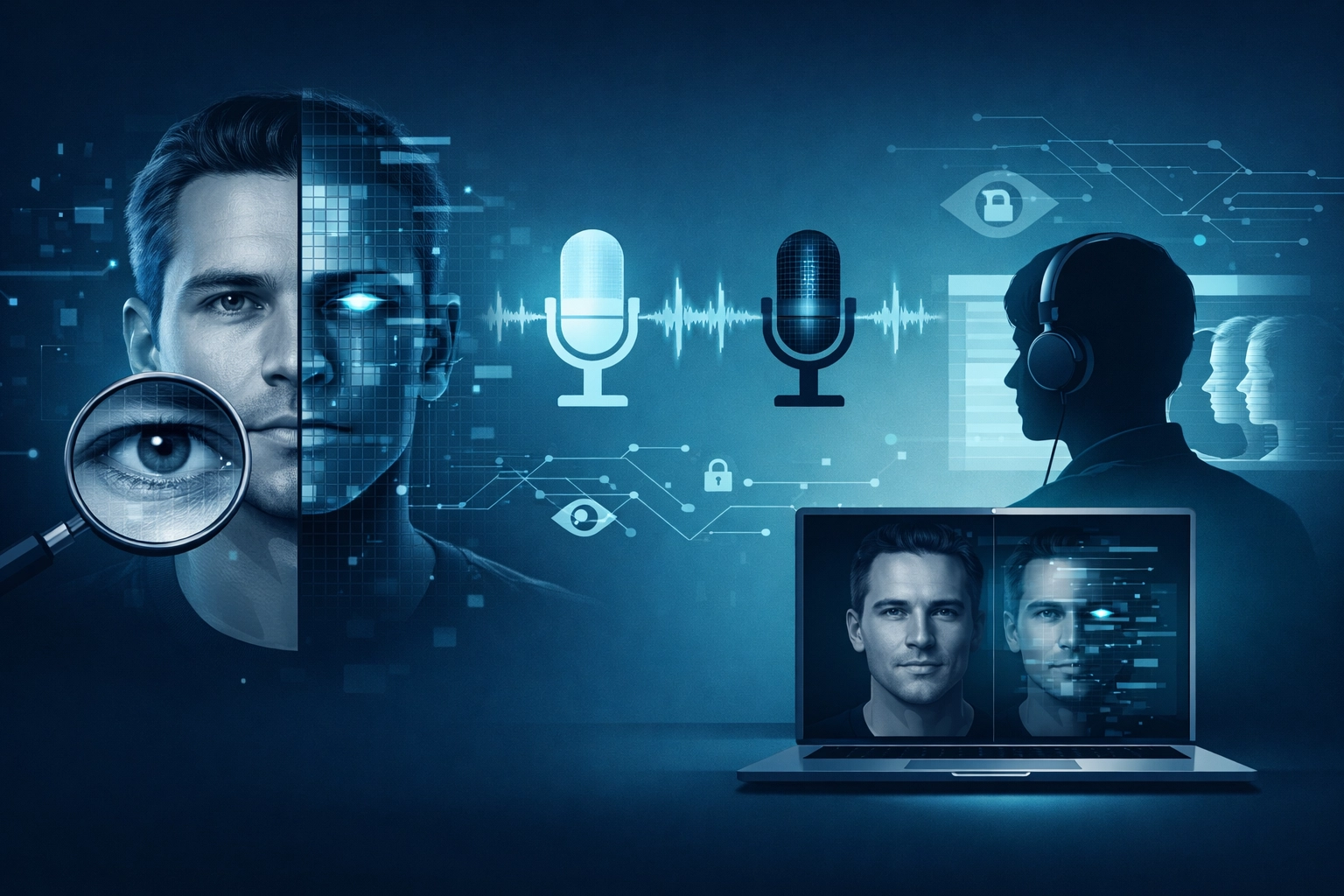
In the rapidly evolving landscape of 2026, the lines between digital reality and synthetic fabrication have become increasingly blurred. For many organizations, the greatest threat no longer comes from a hooded hacker in a dark room, but from a familiar voice on the phone or a recognizable face on a Zoom screen. Generative AI has moved from a novelty to a sophisticated weapon in the hands of social engineers.
At Credo Cyber Consulting LLC, we’ve seen a dramatic shift in how “Agentic AI” is being utilized to bypass traditional security perimeters. If you want to understand how we moved from simple chatbots to AI that can autonomously execute tasks, check out our deep dive into Agentic AI 101. As these tools become more accessible, your staff members, from the C-suite to the front desk, are now the primary targets for deepfake-driven fraud.
The New Reality of Social Engineering
Deepfakes and voice clones are no longer just for Hollywood or political propaganda. They are used daily to perpetrate “Business Email Compromise 2.0,” in which a “CEO” calls the finance department to authorize an urgent wire transfer, or a “vendor” joins a video call to discuss a change in payment details. According to recent cybersecurity trends, incidents of AI-enabled fraud rose significantly through 2025, leading to billions in global losses.
The psychological impact is profound. When we see a face we recognize and hear a voice we trust, our critical thinking defenses naturally lower. This is why educational empowerment is the most critical layer of your defense strategy.
Where Do the “Digital Seeds” Come From?
Most deepfake and voice-clone attacks do not start with an attacker “creating” a person from scratch; rather, they begin with the attacker harvesting data that has already been made publicly available (often by well-intentioned professionals doing normal things like marketing, recruiting, speaking, and networking).
In a hyper-connected environment, the raw material is everywhere, including:
- Short social clips on LinkedIn, YouTube, and Instagram
- Podcast guest appearances and highlight reels
- Recorded webinars, keynote recordings, and virtual panels
- Corporate “About Us” pages, testimonials, and leadership videos
From a practical perspective, as little as 3–10 seconds of audio (or a few seconds of video with clear speech) may be sufficient for modern tools to begin producing a convincing voice approximation, particularly when the goal is social engineering rather than studio-quality impersonation. It should be assumed that routine public content can be repurposed into “digital seeds” for an impersonation attempt.
The uncomfortable takeaway is this: in a world where everyone is publishing content, many organizations and individuals unknowingly supply the training set for their own digital clones, which is precisely why verification procedures and staff awareness must be treated as operational necessities rather than “nice-to-have” training topics.

Step 1: Listen for Artificial Speech Patterns
The first step in identifying a voice clone is to look past the words and focus on the delivery. While AI has become incredibly good at mimicking timbre, it often struggles with the subtle nuances of human prosody: the rhythm, stress, and intonation of speech.
U.S. government guidance has emphasized that synthetic media (including AI-generated audio) may still exhibit perceptible artifacts, particularly when generated quickly for social engineering, and that personnel awareness remains a key control when technical verification is unavailable (Cybersecurity and Infrastructure Security Agency, Contextualizing Deepfake Threats to Organizations, 2023).
Actionable Tip for Staff: Listen for a “flatness” in the voice. If the speaker sounds like they are reading a script with perfect, unchanging energy across every sentence, it is a red flag. Pay attention to “glitches”: small, digital artifacts that sound like a skipping CD or a slight metallic ring at the end of words.
Step 2: Check for Inconsistent Pacing and Rhythm
Humans have a natural “cadence.” We speed up when we are excited and slow down when we are explaining something complex. Synthetic speech, on the other hand, often suffers from irregular timing or, conversely, an unnaturally smooth flow that lacks the “stutter-step” of real conversation.
In a typical deepfake scenario, the AI might process information in bursts, leading to strange gaps between sentences that don’t align with a human thought process. Furthermore, CISA has noted that synthetic media can be weaponized at scale to create believable impersonations, making “pressure + urgency” scenarios especially risky when recipients do not pause to verify identity through trusted channels (Cybersecurity and Infrastructure Security Agency, Contextualizing Deepfake Threats to Organizations, 2023).
Actionable Tip for Staff: If the person on the other end of the line is rushing through a high-stakes request, like an urgent wire transfer, deliberately interrupt them. Ask a complex, open-ended question that requires a nuanced answer. Real people can pivot their rhythm instantly; AI models may lag or produce a nonsensical, disjointed response.
Step 3: Analyze Pitch and Tone Variations
Deepfake audio often fails the “emotional resonance” test. When a person is stressed, their pitch usually rises. When they are calm, it settles. Deepfake and synthetic-media risk guidance has consistently highlighted that convincing impersonations can override normal skepticism, which is why verification procedures (not “how real it sounds”) should be the deciding factor for high-risk requests (Cybersecurity and Infrastructure Security Agency, Contextualizing Deepfake Threats to Organizations, 2023).
In many reported cases of voice cloning fraud, employees noted that the “manager” sounded exactly like themselves but seemed strangely devoid of their usual personality or humor. This is a key indicator of a synthetic impersonation.

Actionable Tip for Staff: Look for “pitch jumps.” These are sudden, sharp changes in the voice’s frequency that don’t match the emotion of the sentence. If the “CEO” is supposedly calling from a busy airport but their voice remains perfectly modulated and calm while asking for an emergency bank change, trust your gut: it’s likely a fake.
Step 4: Verify Background Noise and Breathing Patterns
This is often the “smoking gun” of a deepfake. Real human beings breathe. We take breaths before long sentences, and we make subtle mouth sounds (lip smacks, soft inhales). Many AI voice models omit these entirely or insert them at mathematically “logical” intervals that don’t match actual physical exertion.
Furthermore, consider the ambient environment. In a real-world call, there is background noise: the hum of an office, the sound of wind, or the clatter of a coffee shop. In many synthetic-audio attacks, the background may sound unnaturally consistent (or “studio clean”), and CISA has advised that awareness training should include these kinds of telltale cues alongside stronger verification workflows (Cybersecurity and Infrastructure Security Agency, Contextualizing Deepfake Threats to Organizations, 2023).
Actionable Tip for Staff: If a call sounds “too quiet,” be suspicious. Ask the caller about their surroundings. If they say they are at a conference but you hear absolute silence or a generic “crowd noise” loop that doesn’t change when they move, you are likely dealing with a clone.
Step 5: Compare Against Known Voice Samples and Use Verification Protocols
Technology can be used to fight technology, but the human element remains the strongest verification tool. When a suspicious call occurs, staff should mentally (or, if a recording is available, physically) compare the audio to what they know of the person. Does the “voiceprint” match their usual cadence, typical word choices, and emotional baselines?
However, the most effective defense is a Physical Verification Protocol. We recommend that all organizations implement “Out-of-Band” (OOB) verification for any sensitive request. If you receive a call from a “director” on an unknown number or via a video platform, hang up and call them back on their known, company-issued cell phone or reach out via a trusted internal messaging system.

Actionable Recommendation: Implement a “Safe Word” or a “Challenge-Response” system for high-risk departments. This is a non-digital secret, shared only in person between team members, that can be used to verify identity during an urgent request. If the caller can’t provide the “Challenge” response, the conversation ends immediately.
Why This Matters for the Mission of Your Organization
Cybersecurity is not just about firewalls and passwords; it is about protecting your organization’s mission. When an employee is tricked by a deepfake, the damage isn’t just financial: it’s a breach of trust that can paralyze a team. This is a topic I cover extensively in my book. The Digital Citizen’s Guide to Cybersecurity, where I focus on empowering individuals to navigate the digital world with confidence.
Deepfakes are also being used in more personal ways, such as AI romance scams, which can lead to “sextortion” or credential theft that eventually impacts the workplace. Educating your staff on these threats protects them both professionally and personally.
Developing a Culture of Skepticism
The goal of this guide isn’t to make your staff paranoid, but to make them “professionally skeptical.” In the era of AI, we can no longer afford to take digital identity at face value.
To help your team stay ahead of these threats, consider the following checklist for your next internal training session:
- Stop and Think: Is this request unusual? Does it bypass our standard operating procedures?
- Verify the Channel: Am I talking to this person on a trusted, verified platform?
- Test the AI: Ask a question only the real person would know, something personal or related to an unrecorded office joke.
- Report Immediately: If a deepfake is suspected, report it to IT/Security immediately. These are often coordinated attacks, and your “near miss” could save a colleague from being the next target.
As we look toward the future of security, aligning your team’s awareness with robust technical controls is the only way to close the 82:1 Identity Gap.
At Credo Cyber Consulting LLC, we believe that education is the ultimate equalizer. By teaching your staff to spot the “glitch in the matrix,” you turn your workforce from a vulnerability into your strongest defensive asset.
If you’re ready to build a more resilient, AI-aware culture, let’s talk. You can reach out to us at Credo Cyber Consulting Contact to learn more about our customized training programs and risk management strategies.
References:
- Cybersecurity and Infrastructure Security Agency (CISA). (2023). Contextualizing Deepfake Threats to Organizations. https://media.defense.gov/2023/Sep/12/2003298925/-1/-1/0/CSI-DEEPFAKE-THREATS.PDF
- National Institute of Standards and Technology (NIST). (2024). Reducing Risks Posed by Synthetic Content: An Overview of Technical Approaches to Digital Content Transparency. https://nvlpubs.nist.gov/nistpubs/ai/NIST.AI.100-4.pdf
- Federal Bureau of Investigation (FBI). (2025). Public Service Announcement: Malicious Actors Impersonating Senior U.S. Officials (Smishing/Vishing with AI-Generated Voice Messages). (Alert referenced by multiple outlets; readers should consult the FBI IC3 and FBI.gov for the original advisory and updates.) https://www.aha.org/news/headline/2025-05-19-fbi-warns-malicious-text-ai-voice-messaging-campaign-impersonating-senior-us-officials
- World Economic Forum (WEF). (2024). 4 ways to future-proof against deepfakes in 2024 and beyond. https://www.weforum.org/stories/2024/02/4-ways-to-future-proof-against-deepfakes-in-2024-and-beyond/
- World Economic Forum (WEF). (2026). How cognitive manipulation and AI will shape disinformation in 2026. https://www.weforum.org/stories/2026/03/how-cognitive-manipulation-and-ai-will-shape-disinformation-in-2026/