


Artificial intelligence has reached a pivotal inflection point. For decades, AI systems have been excellent at responding to human commands: answering questions, generating text, and analyzing data when prompted. However, a new category of AI is fundamentally changing this dynamic. Agentic AI represents a paradigm shift from systems that merely react to instructions to systems that independently pursue goals, make decisions, and execute multi-step actions with minimal human oversight. For decision-makers across corporate, higher education, and K-12 environments, understanding this evolution is not merely academic. It is essential for security risk management, operational planning, and governance frameworks.
The Evolution of Artificial Intelligence: A Brief Historical Context
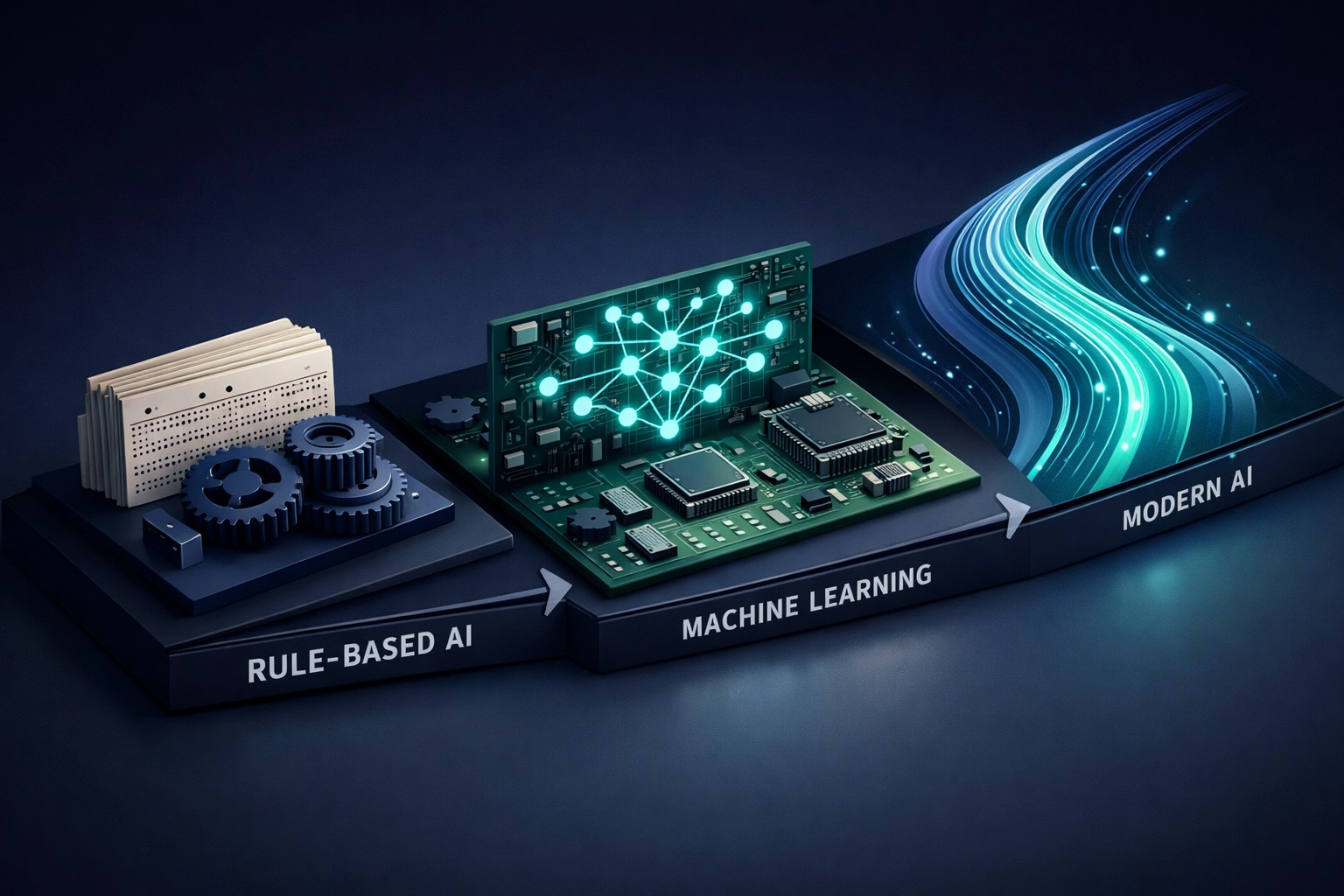
To comprehend the significance of agentic AI, one must first understand the trajectory of artificial intelligence development over the past seven decades.
Rule-Based and Symbolic AI (1950s–1980s)
The earliest AI systems operated on explicitly programmed rules and symbolic logic. These systems, often referred to as “expert systems,” relied on if-then statements and decision trees coded by human programmers. While groundbreaking for its time, rule-based AI was fundamentally limited. It could handle only scenarios explicitly anticipated by its creators and lacked the ability to learn from new experiences or adapt to unforeseen circumstances (IBM, 2024).
Machine Learning and Predictive AI (1990s–2000s)
The emergence of machine learning represented a significant advancement. Rather than following hard-coded rules, these systems could identify patterns in large datasets and make predictions based on statistical analysis. Predictive AI found applications in fraud detection, recommendation engines, and risk assessment. However, these systems remained fundamentally reactive. They analyzed data when prompted and required substantial human interpretation of results (Abou Ali & Dornaika, 2023).
Generative AI (Early 2020s)
The introduction of large language models (LLMs) and generative AI tools marked another evolutionary leap. Systems like ChatGPT, DALL-E, and other generative models could create novel content, text, images, and code in response to human prompts. Generative AI excels at content creation, summarization, and conversational interaction. Yet, as Gupta (2024) notes, generative AI remains “reactive and functional.” It produces output based on detailed instructions, but the output itself represents the process’s endpoint.
Agentic AI (Mid-2020s–Present)
Agentic AI represents the current frontier. Unlike its predecessors, agentic AI is designed to operate autonomously toward high-level objectives, breaking complex goals into actionable steps, executing them across multiple systems, and self-correcting based on feedback, all without continuous human intervention (Capably AI, 2025; Acceldata, 2024).
Defining Agentic AI: Core Characteristics and Capabilities
The term “agentic” derives from the concept of agency, the capacity to act independently and make choices. Agentic AI systems are distinguished by three essential characteristics that set them apart from previous AI paradigms: Autonomy, Adaptability, and Goal-Orientedness.
Autonomy: Independent Decision-Making and Action
Agentic AI operates with substantial independence, determining its own course of action to achieve specified objectives rather than waiting for step-by-step human instructions. As Salesforce (2024) explains, these systems “choose their own course of action and determine how to achieve goals” without requiring constant human guidance. This autonomy extends beyond simple task execution to encompass strategic decision-making about which actions to prioritize and in what sequence.

Adaptability: Real-Time Learning and Strategy Adjustment
Unlike rigid rule-based systems, agentic AI learns from interactions and environmental feedback, adjusting strategies dynamically as conditions change. This adaptability is particularly valuable in complex, unpredictable environments where pre-programmed responses would prove inadequate. The American Journal of Technology Advancement (2024) emphasizes that agentic systems “learn from interactions and feedback, adjusting their strategies in real time” rather than following fixed protocols.
Goal Orientation: High-Level Objective Execution
Humans provide high-level objectives to agentic systems, and the AI takes responsibility for translating those objectives into concrete action plans, sequencing tasks appropriately, and executing them to fulfill the overall goal. This goal-oriented approach represents a fundamental departure from traditional AI, which requires explicit instructions for each step of a process (Frontiers in AI, 2024; Springer, 2024).
The Critical Distinction: Generative AI vs. Agentic AI
Understanding the difference between generative AI and agentic AI is paramount for decision-makers evaluating AI implementation strategies. While both represent advanced AI capabilities, they serve fundamentally different purposes and operate according to distinct paradigms.
Generative AI is reactive, prompt-dependent, and designed for content creation. When a user inputs a prompt, the system generates a response such as text, images, or code, and that output represents the conclusion of the interaction. The AI does not initiate actions, monitor outcomes, or pursue objectives beyond responding to the immediate request (Gupta, 2024).
Agentic AI, conversely, is proactive, goal-driven, and designed for autonomous action execution. Rather than simply generating content in response to prompts, agentic systems observe their environment through APIs, sensors, or data feeds; establish goals and create multi-step action plans; execute those plans while monitoring progress; and adapt based on feedback and changing conditions (Acceldata, 2024; Capably AI, 2025).
Consider a practical example: A generative AI chatbot might answer a customer’s question about a shipping delay when prompted. An agentic AI system, however, might proactively detect the delay through integration with logistics systems, automatically reroute the delivery, notify the customer through appropriate channels, update inventory management systems, and generate a report on the incident, all without human intervention beyond the initial goal-setting of “optimize delivery reliability.”
How Agentic AI Functions: Architecture and Mechanisms
Agentic AI systems combine multiple AI models and technologies to achieve autonomy. As Capably AI (2025) explains, these systems integrate “large language models (for flexible reasoning) with deterministic programming (for reliability and speed),” providing both adaptability and operational stability.
The operational cycle of agentic AI typically involves four key phases:
- Observation: The system continuously monitors its environment through data feeds, APIs, sensor networks, or other information sources relevant to its assigned objectives.
- Planning: Based on observed conditions and defined goals, the agent creates action plans, determines task sequences, and allocates resources appropriately.
- Execution: The system implements its plan by executing actions across multiple systems and platforms as needed to achieve objectives.
- Adaptation: Throughout execution, the agent monitors outcomes, evaluates progress toward goals, and adjusts strategies based on feedback and changing circumstances (Acceldata, 2024).
This multi-step execution capability allows a single agent to identify problems, gather information from disparate systems, decide on optimal solutions, and follow through to resolution, a level of autonomous operation previously impossible with traditional AI architectures.

Implications for Organizations: Why Agentic AI Matters
The emergence of agentic AI carries significant implications for organizational operations, governance, and security risk management. For decision-makers in corporate, higher education, and K-12 environments, several critical considerations demand attention.
Operational Scalability and Efficiency
Agentic AI enables organizations to handle complex workflows autonomously, reducing the need for constant human oversight while maintaining or improving operational effectiveness. This scalability is particularly valuable for organizations facing resource constraints or seeking to optimize staff allocation toward higher-value strategic activities (Salesforce, 2024).
Enhanced Decision-Making Speed and Quality
By processing information across multiple systems simultaneously and executing decisions in real-time, agentic AI can significantly accelerate organizational response times to emerging challenges or opportunities. This acceleration is especially relevant for time-sensitive domains such as cybersecurity, logistics, and customer service.
New Governance and Risk Management Challenges
The autonomous nature of agentic AI introduces novel governance challenges that organizations must address proactively. Questions of accountability, oversight, identity management for AI agents, and the application of least-privilege principles to autonomous systems require new frameworks and policies. As organizations increasingly deploy these systems, establishing appropriate governance structures becomes imperative for risk mitigation and compliance maintenance.
Workforce Transformation and Collaboration
Agentic AI is designed to work collaboratively with both humans and other AI systems, creating hybrid operational models that leverage the strengths of both human judgment and machine capabilities. Organizations must consider how workforce roles, training programs, and operational procedures will evolve to accommodate these collaborative models effectively (Springer, 2024; Frontiers in AI, 2024).
Preparing for the Agentic AI Era
As agentic AI transitions from experimental implementations to mainstream organizational tools, decision-makers should consider several preparatory actions:
- Evaluate current AI capabilities and identify opportunities where autonomous goal-oriented systems could provide operational value while managing associated risks appropriately.
- Establish governance frameworks that address accountability, oversight, and security considerations specific to autonomous AI agents before widespread deployment.
- Invest in cybersecurity training that prepares staff to work alongside autonomous AI systems and understand the security implications of AI-driven operations.
- Assess existing infrastructure and data systems for compatibility with agentic AI integration, identifying gaps that may require remediation.
- Engage with legal and compliance teams to ensure that autonomous AI operations align with regulatory requirements and organizational policies.
The evolution from AI that talks to AI that does represents more than a technological advancement, it signifies a fundamental shift in how organizations can leverage artificial intelligence to achieve objectives. Understanding this transformation, its implications, and the requirements it entails is essential for decision-makers seeking to position their organizations effectively for the future.
For organizations navigating these complex transitions, Credo Cyber Consulting provides expert guidance on integrating emerging technologies while maintaining robust security postures and governance frameworks. The agentic AI era has arrived. The question is not whether to engage with it, but how to do so strategically, securely, and successfully.
References:
Abou Ali, N., & Dornaika, F. (2023). Artificial intelligence evolution and applications. arXiv preprint.
Acceldata. (2024). Understanding agentic AI: The next frontier in autonomous systems.
American Journal of Technology Advancement. (2024). Agentic AI: Characteristics and capabilities.
Capably AI. (2025). The fundamental shift from traditional AI to agentic AI.
Frontiers in AI. (2024). Goal orientation in autonomous artificial intelligence systems.
Gupta, P. (2024). From reactive to proactive: The evolution of AI systems. Medium.
IBM. (2024). The history of artificial intelligence: From expert systems to machine learning.
Salesforce. (2024). Agentic AI: Autonomous decision-making and organizational impact.
Springer. (2024). Workforce transformation in the age of autonomous AI.