

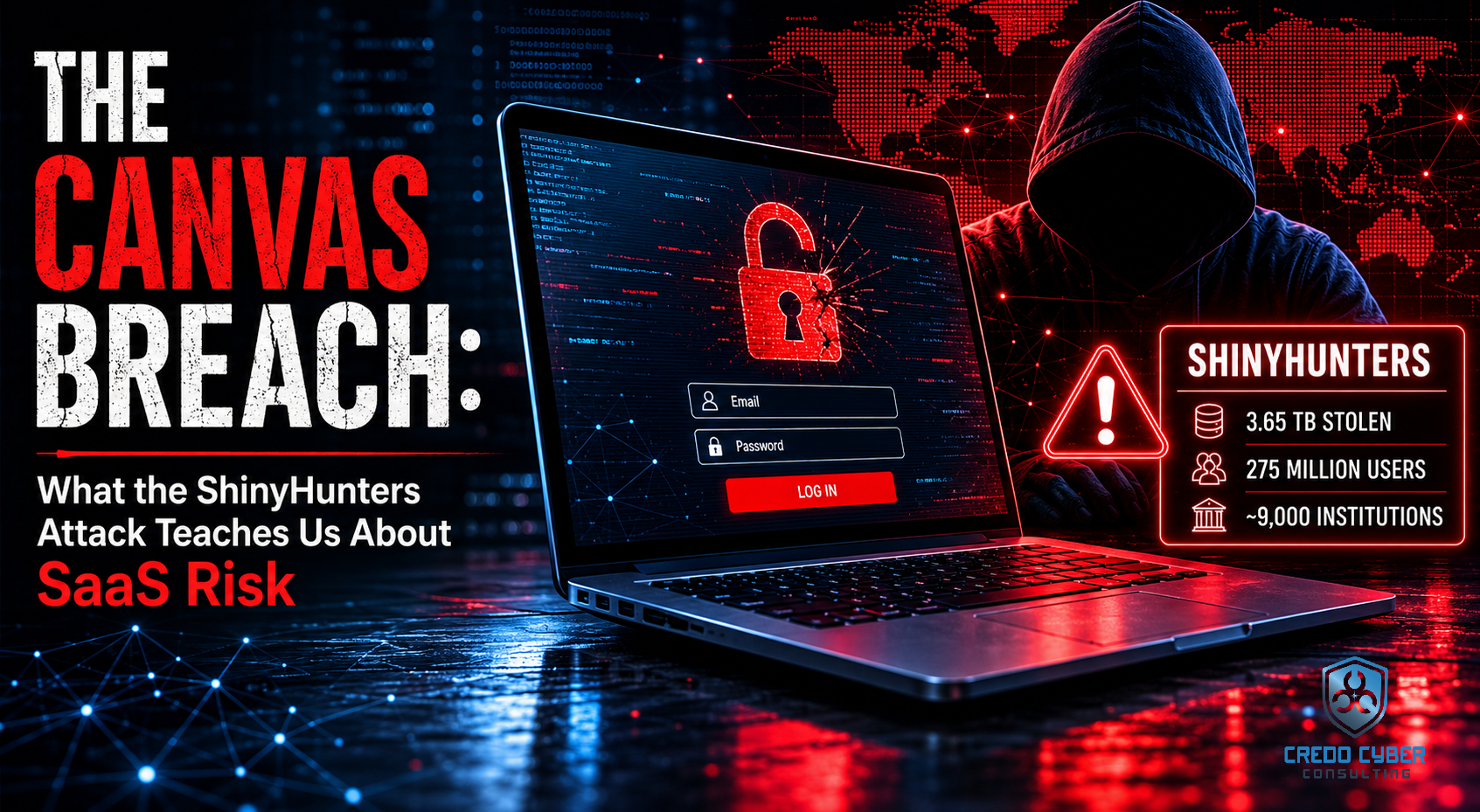
The move to Software-as-a-Service (SaaS) was supposed to simplify our lives. For educational institutions and corporations alike, outsourcing infrastructure to specialists like Instructure, the makers of the Canvas Learning Management System (LMS), promised better uptime, lower overhead, and seamless scaling. However, as the events of April and May 2026 have demonstrated, this centralization of data also creates a centralized target.
The ShinyHunters attack on Canvas is not just another data breach; it is a seminal moment in security risk management. It highlights the fragility of the SaaS supply chain and the devastating impact of “concentration risk.” When one platform serves 40-50% of the higher education market, a single point of failure becomes a sector-wide crisis. At Credo Cyber Consulting LLC, we believe understanding the technical and operational failures of this incident is paramount for any organization looking to align its security with its mission.
The Adversary
Who are ShinyHunters?
To understand the Canvas breach, one must first understand the threat actor. ShinyHunters is a financially motivated cybercriminal and extortion group that first rose to prominence between 2020 and 2021. Unlike state-sponsored actors who may seek long-term espionage, ShinyHunters operates with a “smash-and-grab” philosophy augmented by sophisticated extortion tactics.
The group specializes in:
- Credential Theft: Harvesting usernames and passwords through phishing and infostealer malware.
- Cloud Account Compromise: Targeting misconfigured AWS, Azure, and Snowflake environments.
- Data Theft and Extortion: Stealing massive datasets and demanding payment to prevent their release.
- “Name-and-Shame” Tactics: Publicizing breaches on leak sites to apply maximum pressure on victims.
By 2026, they had refined their operations into a highly efficient pipeline. Their involvement in the 2024 Snowflake campaign (discussed below) provided the blueprint for the Canvas attack: find the weakest link in a highly connected ecosystem and exploit it to gain access to the “crown jewels.”
The 2024 Snowflake Campaign
The operational patterns seen in the Canvas breach were first established during the massive 2024 campaign against Snowflake customers. During that period, attackers associated with ShinyHunters targeted major entities including Ticketmaster, AT&T, and Santander.
According to reports from Mandiant and CISA, Snowflake’s infrastructure itself was not breached. Instead, the attackers exploited the “human element” of security. They used stolen credentials, often obtained from infostealer malware logs, to access accounts without Multi-Factor Authentication (MFA).
The critical weaknesses identified in the Snowflake campaign included:
- Lack of MFA on service accounts: Allowing attackers to bypass traditional login hurdles.
- Credential reuse: Using passwords leaked in unrelated breaches to access sensitive data warehouses.
- Overprivileged roles: Once inside, attackers had the permissions necessary to export billions of records without triggering immediate alarms.
This established a dangerous precedent: attackers do not need a “zero-day” exploit if they have valid credentials. This lesson is at the heart of modern cybersecurity training.
The 2026 Canvas Breach Timeline
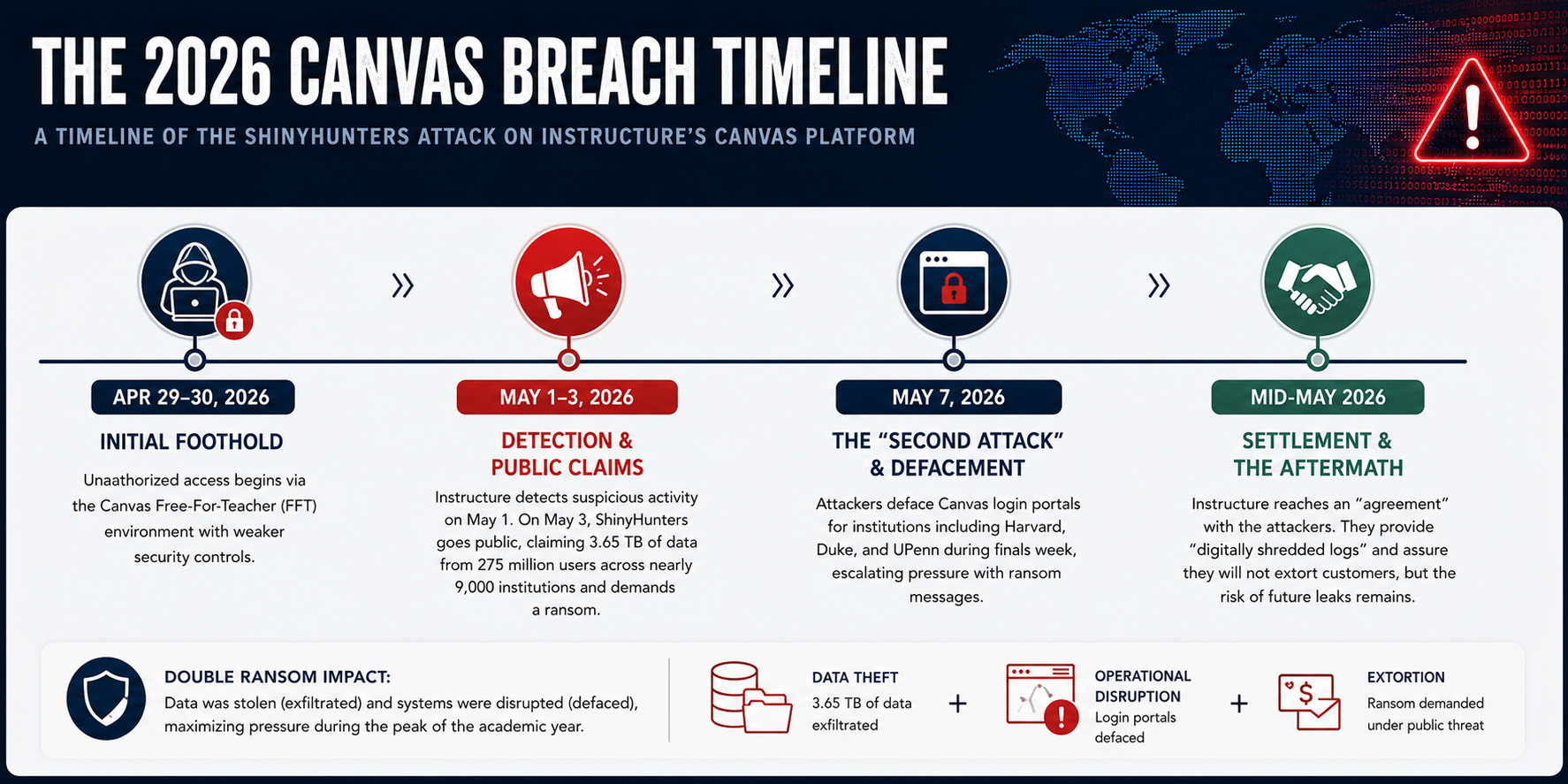
The attack on Instructure’s Canvas platform followed a calculated timeline designed to maximize operational pressure. By striking during the peak of the academic year, the attackers ensured their demands would be met with urgency. They used a method that is becoming increasingly common: The Double Ransom Attack. This is when an attacker breaches an organization, launches an attack, and then launches a second attack with additional demands.
Initial Foothold (Late April 2026)
Between April 29 and April 30, unauthorized access began. Reports from security researchers suggest the initial entry point was the Canvas “Free-For-Teacher” (FFT) environment. This environment, designed for individual instructors and small-scale use, appears to have had less stringent security controls than the enterprise-tier production systems.
Detection and Public Claims (May 1–3, 2026)
Instructure detected suspicious activity on May 1. However, by May 3, ShinyHunters went public, claiming they had exfiltrated approximately 3.65 TB of data belonging to 275 million users across nearly 9,000 institutions globally. The stolen data reportedly included names, email addresses, student IDs, and private messages between students and faculty. ShinyHunters demanded a ransom, but Instructure was resistant.
The “Second Attack” and Defacement (May 7, 2026)
The situation escalated dramatically on May 7. Despite initial containment efforts, attackers were able to deface the Canvas login portals for several prestigious institutions, including Harvard, Duke, and the University of Pennsylvania. These pages were replaced with ransom messages, effectively holding the schools’ digital front doors hostage during finals week.
The Settlement and the Aftermath
By mid-May 2026, Instructure announced it had “reached an agreement” with the attackers. While the company used careful language, most industry analysts interpret this as a ransom payment. The attackers provided “digitally shredded logs” as proof that the stolen data was deleted along with an assurance that they would not extort Instructure customers in the future.
However, when dealing with cybercriminals, there is no such thing as a “guarantee” when dealing with extortionists. Once data is exfiltrated, the risk of future leaks or secondary sales on the dark web remains a permanent concern.
Technical Failures and SaaS Risk
The Canvas incident serves as a masterclass in why it is imperative that your cybersecurity program must focus on more than just “patching bugs.” The breach resulted from several systemic and operational failures.
1. Inadequate Segmentation
The ability for attackers to move from the Free-For-Teacher environment into the broader Canvas infrastructure suggests a lack of robust network segmentation. In a SaaS model, “tenant isolation” is non-negotiable. If a breach in a low-security environment can pivot to a high-security enterprise environment, the isolation has failed.
2. Overprivileged Admin Tooling
The scale of the data exfiltration, hundreds of millions of records, indicates that the attackers obtained administrative credentials with broad export capabilities. Under the principle of “Least Privilege,” no single account or support tool should be able to bulk-export global user data without multiple layers of authorization and monitoring.
3. Persistence and Remediation Gaps
The May 7th defacement was a clear sign of a persistent failure. After the initial breach is identified, incident response teams must “hunt” for backdoors, long-lived session tokens, and compromised API keys. The second wave of attacks proved that the initial containment was incomplete, leaving the adversary with active access to production systems.
4. SaaS Concentration Risk
This incident highlights the “All Your Eggs in One Basket” problem. When a single vendor controls the primary communication and assessment channel for most of a sector, that vendor becomes part of the organization’s critical infrastructure. If Canvas goes down or is compromised, the entire education sector faces a business continuity crisis.
Core Lessons for Organizations
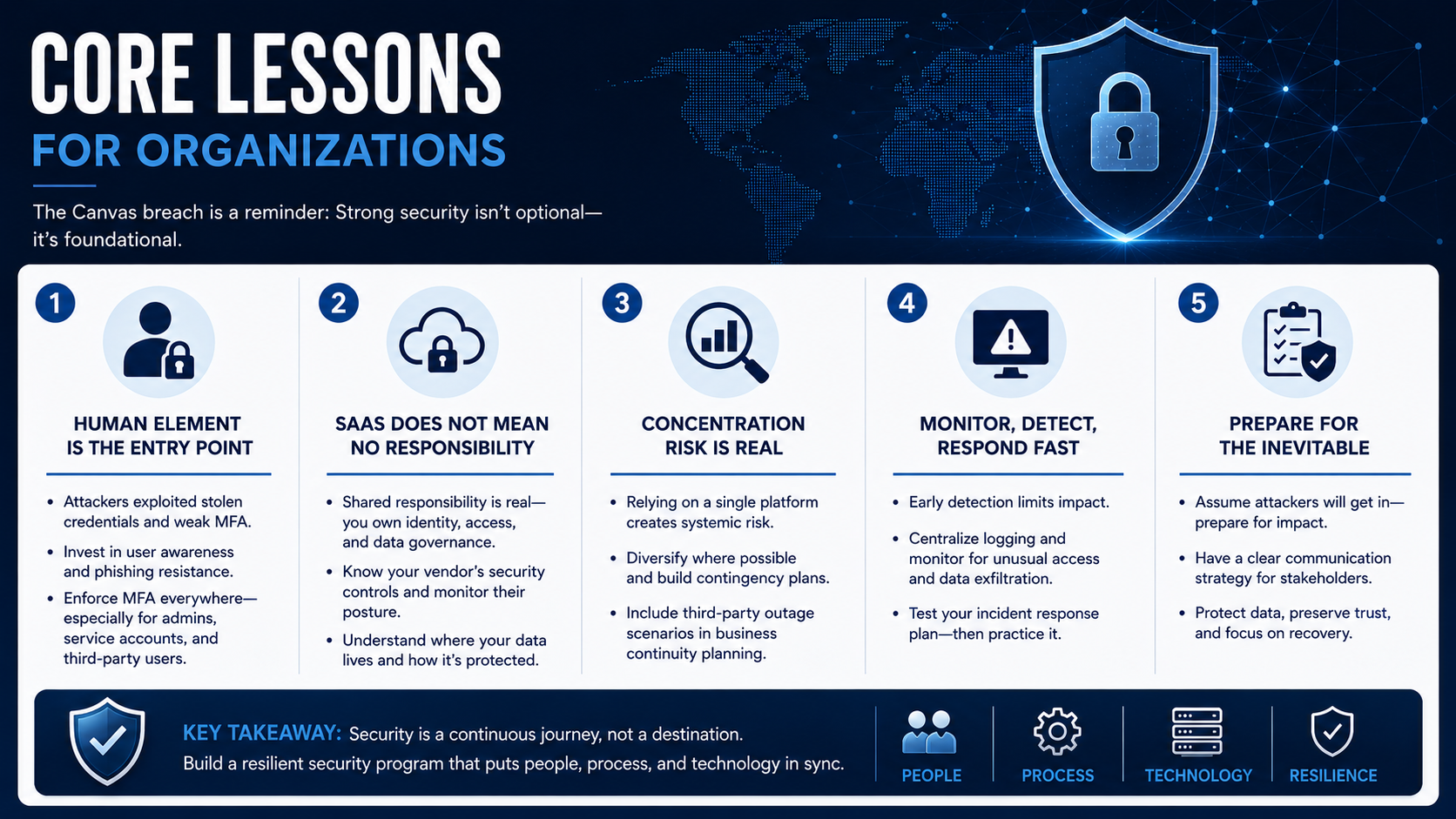
What can we learn from the ShinyHunters campaign against Canvas and Snowflake? We recommend several actionable steps to mitigate these risks:
- Mandatory MFA Everywhere: This is no longer optional. Every service account, API key, and “free” account tied to your domain must be protected by robust Multi-Factor Authentication.
- Secure the Support Surface: Support systems and backend admin tools are high-value targets. They often have the keys to the kingdom but are frequently overlooked in standard audits.
- Implement Data Minimization: Ask yourself, “Do we need to store this much data in the cloud?” Reducing the volume of PII and sensitive data stored in third-party platforms reduces your “blast radius” in the event of a third-party breach.
- Prioritize Persistence Hunting: During an incident, do not assume the attacker is gone simply because the initial entry point has been closed. Rotate all credentials and invalidate all active sessions across the entire ecosystem.
- Review SaaS Integrations: For educational institutions, conduct regular audits of LTI tools (based on the Learning Tools Interoperability Standard), marketplace apps, and developer keys that access your LMS. For enterprise organizations, regularly review all APIs and data-flow operations for sensitive and confidential data stores.
References and Further Reading:
- Mandiant (2024). “UNC5537 Targets Snowflake Customer Instances.”
- CISA (2026). “Alert: Strengthening Security for SaaS-Based Educational Platforms.”
- FBI (2026). “The Evolution of Extortion: ShinyHunters and the 2026 Campaign.”